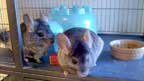
Cat foods include one or more sources of: protein, fat, soluble carbohydrates, fiber and vitamins and minerals. PetEducation.com[1] offers a guide to cat foods.
Some companies make a raw food diet for cats, which consists mostly of raw meat. The raw diet is controversial, so cat owners should do their own research. Amazon[2] offers books on raw diets and holistic health for cats.
Additional costs:
The average cat owner spends $41 per year on treats and $31 per year on vitamins, according to a pet owner survey by The American Pet Products Manufacturers Association.
Discounts:
Some retailers and manufacturers, such as Nutro and Blue Seal[3] have frequent buyer programs that allow customers to receive a free bag of cat food after purchasing 10 to 12 bags.
Shopping for cat food:
The Menu Foods pet-food recall that began in early 2007 has continuing implications for cat owners. The U.S. Food and Drug Administration[4] offers current information on the recall. And ThePetFoodList[5] offers a list of cat foods that were and were not part of the recall, as a starting point for consumers who want to do their own research.
Look at the labels for high quality protein -- such as meat or fish -- at the top of the list. By federal law, manufacturers must list ingredients by weight. PetEducation.com[6] has a primer on selecting a cat food.
Consider the cat's life stage, weight, activity levels and any food allergies or sensitivities -- which, in cats, most commonly involve fish, beef or dairy products. PetEducation[7] has a primer on food sensitivities and allergies.
7 Lesser-Known Discounts for the 50+ Crowd As they age, members of the Baby Boomer generation don't like to admit that they're senior citizens, but they love getting discounts. It's kind of a quandary, because some of the best deals available are reduced prices for older folks. || Posted October 21 2013
7 Ways to Stretch Your Reduced Food Budget End of the year budgets are tight for everyone, especially in this economy.It's especially hard for the millions of Americans who depend on government programs like food stamps to help make ends meet. || Posted November 11 2013
We won't do Purina products, which aren't all that inexpensive these days either. A 3 lb bag will cost at least $36 now, and the cheapest not-garbage type food in a 11-14 lb bag is $65+. In any Vet brand 3 lb bags start 1t $65. It's highway robbery. All the excuses by corporations conveniently aren't backed by hard evidence.
In NB Canada, the cheapest canned food I have been able to find is about $0.60/can. He gets 1 and 1/2 cans a day so roughly 45 cans/month. My cat never drinks water so I only give him wet food and wet treats.
Brand of Food: Friskies,fancy feast, all natural dry fo
My husband gets mad at me all the time due to cost of cat foid. Meanwhile my weiner dogs eat fresh cooked chicken. Go figure. Plus there is a family of 2 adults, 2 kittens that I feed as well. But shhh..don't tell my hubby lol
Im not sure where youre getting your food prices and info on raw meat cat food so for people who dont know....cats are carnivores. Just like lions, pumas, tigers, etc. It is not natural for them to drink water. They in fact get most of their liquid needs met from the blood of the animals they kill. 2 birds a day, or 2 mice a day is their natural diet. A cats body simply CAN NOT break down ANY carbohydrates. Thats why dry food can be very unhealthy for them depending on the brand. I feed my babies raw ground up chicken, rabbit, elk, and so on from Woodys Pet Deli. Its actually CHEAPER than any cat food and my babies love it. Just an fyi. Thanks! Love those babies feline or canine.
I am on disability. unable to drive-or carry anything heavy, my 25-year credit Union 'ALLOWED' complete theft of my disability pension & All Savings--which They REFUSE to Credit. I've 6 rescues-two that have lost drastic amounts of weight-but were better once i rescued them from abandonment at a foreclosed house. I'm skipping needed Rx's to feed the 6, (all fixed), plus a stray (Alpha) in the garage. I don't have enough $ to get moist food & litter.....I've saved 100's of kittens from a feral colony, using my own limited income to by KMR, and find them 4Ever homes, once they were at Least 8 weeks. I need help with litter & moist food...I'm no good to help them If I'm bedridden. No One delivers, unless you pay. To what do my hungry kitties, do I say?
CostHelper is based in Silicon Valley and provides consumers with unbiased price information about thousands of goods and services. Our writers are experienced journalists who adhere to our strict editorial ethics policy.
CostHelper Community
UTI urgent care visit Paid: 147.00 Visit was $135. Antibiotics was $12. Waiting for four hours in the waiting room and the visit was quick... [more]
Spanish Medical Interpreter Paid: 150.00 I worked with SynShyne Services out of Monroe, NC. They were so worth the price! Professional, friendly, accurate, great attitude and always on time. I recieved an itemized report after every contact and a user friendly invoice weekly... [more]
Skin prick allergy test Paid: 573.00 Took my 9 yr. old in after an allergic reaction to eggs. Several panels for nuts, fish & top 8 allergens. Sure enough, egg came up. Got a script for epinephrine and left... [more]






 Post
Post