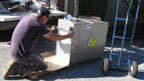
Loosely defined, a handyman performs a wide range of basic home maintenance and repairs ranging from simple ones like fixing a squeaky door, hanging storm windows, to more complex projects like installing cabinets or weatherproofing. A lot depends on the expertise of the individual handyman or service company and the desires of the homeowner.
Typical costs:
Traditionally most handymen worked independently, setting their own hours and rates and gaining reputations by word of mouth. In the last few decades, professional handyman "services" have sprung up, either as local businesses with teams of employees or as a national chain.
Expect to pay about $30-$50 an hour for an independent handyman in rural or less expensive areas and $40-$60 an hour in more urban locations or regions with a higher cost of living. These rates are just average estimates, and will vary considerably by region and by individual worker. Some handymen charge a lump sum for a specific project, depending on the complexity.
Depending on the skills needed, rates run $60-$125 an hour for a professional handyman company. There's often a $150-$350 minimum charge and there can be a $30-$100 "trip" charge (if the worker needs to go buy materials). A professional handyman company usually has several employees, providing a wider range of skills, and screens employees for experience and reliability.
Make a list of everything that needs doing, because it's usually cheaper to have it all done at once rather than as separate small projects. Ask if you can purchase basic supplies on your own time instead of paying the handyman to drive to get them.
It's not always cheaper to hire a handyman instead of a licensed specialist to perform extensive plumbing or electrical projects, or other complex work. A handyman could be unfamiliar with what's needed and take a lot longer to do the job. In some states handyman can work without a contractor's license as long as they stick to minor repair work, but bigger jobs usually require a contractor's license. Check with local and state officials.
Discounts:
Some agencies offer free or low-cost home repairs for low-income seniors; check with your local senior center or department on aging, but be aware that these programs frequently have a waiting list.
Shopping for a handyman:
The Colorado Springs Gazette details questions to ask when hiring a handyman and lists common scams. Experts warn against scam artists who operate with little more than a truck, tools and cell phone; they collect deposits and then leave town without doing the work.
For referrals to a good local handyman, check with friends and relatives or ask for recommendations from a locally owned hardware store or real estate management firm. If you pick a handyman from a phone listing (without any sort of word-of-mouth recommendation), some experts suggest checking with local law enforcement for a police record.
When using a service, ask about turnover rates and how they screen their employees.
Whether using an independent handyman or a nationally-linked service, get several estimates and a final written bid/contract that specifies what work will be done, including start and finish times, payment schedules, type of materials used and who will provide them, and whether the handyman will pull the necessary permits for a larger project.
Even an independent should be bonded and have a business license as well as liability and workers' compensation insurance. Request at least three references and check them all. If applicable, check whether the handyman is licensed in your state.
7 Lesser-Known Discounts for the 50+ Crowd As they age, members of the Baby Boomer generation don't like to admit that they're senior citizens, but they love getting discounts. It's kind of a quandary, because some of the best deals available are reduced prices for older folks. || Posted October 21 2013
7 Ways to Stretch Your Reduced Food Budget End of the year budgets are tight for everyone, especially in this economy.It's especially hard for the millions of Americans who depend on government programs like food stamps to help make ends meet. || Posted November 11 2013
John Otis is the handyman he is great I mean absolutely great he works for a company named 2 men and a hammer and they are Knowledgeable about everything I have been using him for about five years and he knows a little bit of everything I would recommend him to anyone. Contact them at [email protected] if you live in the Cincinnati Ohio area or NKY
A good friend hooked me up with this handy person about a year ago and I can't thank her enough. He does about everything you could have on that honeydo list and is always polite, respectul and on time. Great work and very afordable. Even shows up on weekends if you need him to! 602-332-2759
The most inconsiderate, unreliable, dishonest service around. After he stretched out a 1 month job to almost 12 months, I need thousands of dollars more repairs than I did when he started. Don't believe his sales pitch. Run the other way as fast as you can!
Noticed there were two identical twin workers,. when they left i realized one was distracting me outside while the other was stealing from my back bedrom. Business is Owned by Jeff Cullen
He was very professional, explained each stage of the specified work. He was on time an most importantly, it was done right. He built my new deck 24x36 w/railings and stairs.
BARNETTS CONSTRUCTION handyman specialist. They are very professional. Hung some doors. Remodeled my whole kitchen.they are great.their number 2562039011
Eric Olsen. Stay away from this drunk horny creep and his horny little dog. His estimates are jacked up.work is crappy. not trustworthy. Been known to work with creepy realtor mike, also a scammer.formerly of san jose. Later Moved to northern calif before 2013.
My sister needed the batteries replaced in her remote controlled window blinds that are 20 ft high inside her home,as well as the smoke alarms on the 20 ft high ceiling.She couldn't find anyone willing to do it.So I googled and found Mesquite,Tx #1 handyman .He quickly responded and had the project completed the next morning in less than a hour.He came equipped and ready to the job.My sister was most impressed with his professionalism,common courtesy and cleanliness.Her exact words were " A Texas Gentleman." I and other family member have used his services since.He is highly skilled in all trades and was willing to work within our budget.SAVE yourself time and money and call 0r text Case Mcfarland 214-646-4555
Scam alert! Charged for work not contracted, some specifically told to NOT do, and some not completed. Was professional at beginning, hostile at end. Be aware!
Byron Smith is his name. This guy is awesome, been using him for 5 years now. Probably the most trustworthy guy I know. I wouldn't let anyone else work in my homes. He has such a broad range of knowledge in everything. He specializes in electrical work but he can do anything from plumbing to computers. I own 12 rental properties and I use Byron and highly recommend him. I can honestly say you wont find anyone better. email him! [email protected] 214-708-2820
B.Otto Derr has come to my home on multiple occassions for wood, snow and bush removal. scraping and painting my eves and much more tasks. I rely on him so much where i can not do these things. He is friendly, trustworthy, and efficient.
This guy is so awesome he was recommended by a friend, my floor had to be replaced called this guy on weekend he drove a good 35min didn't charge for estimate. I had previously ordered the flooring to match the rest since only a few were going to be replaced he offered to pick it up for us at no additional charge! But when they were getting ready to install the flooring was off by inches come to find out that they no longer make it like I had previously install, so we my wife and I were going to have family over. Sergio is a great man he is so smart he told us not to worry he could fix it AND he did!! It was a little extra because he had to replace more than we had said but my floor looklooks great as if nothing had happened I cant even tell you how he did it but my god it looks even smooth and my wife is happy!! I strongly recommend him to my fam. And friends. Oh I also left him and his helper alone in my home thats how honest he is. 214 815 5306.
Went above and beyond and after he helped with my plumbing issue and fixed some electrical problems I had in my home, he helped limb some dangerous tree branches overhanging my driveway and didn't even include the tree trimming in the total cost! Very professional, diligent, experienced and definitely ensures his customers satisfaction. He's worth every dime.
CALLED SHAWN AFTER HEARING ABOUT SOME WONDERFUL WORK HE DID INSTALLING A WATER HEATER FOR A FRIEND OF MINE, MY FRONT DOOR WAS STUCK SHUT SO HE CAME TO THE RESCUE TO CORRECT THE PROBLEM WITH A NEW PRE HUNG DOOR THAT HE LOCATED & DELIVERED FOR COST . I WANT TO THNK HIM AGAIN FOR DOING SUCH A GREAT JOB. CALL HIM 714-868-1284
I went to use the bathroom about 9p.m when I flush the toilet water started gushing from underneath of it I called elite handyman services to come out for an emergency service call in the charged me 225 dollars an hour they were here for 3 hours and he gave me a first time customer discount bring my total bill to 500 apparently there was a huge clog in my cast iron drain pipe and the wax ring failed causing water to flood out my bathroom they were very quick and very professional they are the only handyman company I trust.
My home was neglected for a few years because of illness, I had numerous projects that needed to be done and done fast since I needed to sell the home....I called him on a Saturday night he came over Sunday morning in the rain and sat down with me for 3 hours....long story short he did my plumbing...painting........carpentry.........all the headache jobs.........very neat.professional gave me great ideas on how to stage the house for sale............Great Guy
I met this handyman named Mike Nero and he gave me his card, well I had a couple friends that needed work done on their homes. .and of course I was reluctant on refuring him cause he said he could do so many different carpentry jobs.long story short , everything he does is like he's worked every construction, handyman service out there.he did a staircase, crown molding, on one house and new lights , patio, remodeled bath, tile new tub ,the works , and he's reasonably priced just email him @ [email protected]
Professional, affordable, and dependable . Victor and his crew were very professional and helped me save on a few major repairs,with their daily rate service, I could save an get 8 full hours of dependable work from the Go2Guys vs paying a few contractor that wanted to charge me to do a complete bathroom and kitchen remodel for an average price of $15,000 . Victor and his crew got the job done professionally for under $7000.00 and spent only 1 1/2 of a week in my home working vs 3-6 weeks bid on contractor time . So give him a call (817)789-3615 ask for Victor
Normal residential rates are $50 commercial is $65 you want someone who is not only capable but insured and has workers comp,like these guys do, or you can risk it and call uncle Joe or pedro and company and do it for a six pack of beer and take all day.
CostHelper is based in Silicon Valley and provides consumers with unbiased price information about thousands of goods and services. Our writers are experienced journalists who adhere to our strict editorial ethics policy.
CostHelper Community
UTI urgent care visit Paid: 147.00 Visit was $135. Antibiotics was $12. Waiting for four hours in the waiting room and the visit was quick... [more]
Spanish Medical Interpreter Paid: 150.00 I worked with SynShyne Services out of Monroe, NC. They were so worth the price! Professional, friendly, accurate, great attitude and always on time. I recieved an itemized report after every contact and a user friendly invoice weekly... [more]
Skin prick allergy test Paid: 573.00 Took my 9 yr. old in after an allergic reaction to eggs. Several panels for nuts, fish & top 8 allergens. Sure enough, egg came up. Got a script for epinephrine and left... [more]






 Post
Post