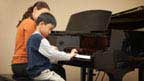
Private weekly half-hour piano lessons usually cost $15-$35, but they can run $40-$75 or more for a half hour with a teacher who has a master's or doctorate degree in music, or other special qualifications. Fees vary based on the teacher's training and experience, if the lessons are at a center or in your home, and whether the teacher offers other services such as performance opportunities or a computer lab. In rural areas, the charge may be $10-$15 per half hour. Many teachers charge monthly, in four-week blocks.
Small group piano lessons run $25-$55 or more a month, depending on the length and size of the class, and the expertise of the instructor. Some group lessons use digital pianos with headphones.
Piano dealers often offer lessons in their showroom, usually included with the purchase of a piano. Typically these are standardized audio lessons heard through headphones and monitored by an on-site teacher.
Do-it-yourself lessons start around $8-$30 for basic books or audio tapes, and can run $50-$350 or more for packages with multiple DVDs, play-along CDs, music books, finger charts, chord charts and other options. Many online lesson sites offer a few free beginner lessons, in hopes that you will purchase more.
Under the Suzuki Method[1] , young children learn by hearing and repetition rather than reading music. With the traditional approach, a student learns to read music a few piano keys at a time, using books designed for beginners.
Many people prefer private one-on-one lessons because a trained teacher can make immediate comments and give encouragement. A half-hour lesson is typical for beginners, because an hour of instruction can be overwhelming. Generally a teacher will review assignments, listen to the student play, provide feedback, explain the theory involved in a particular exercise or piece, and play the assigned work so the student can hear it performed with proper technique and styling. Typically there will an assignment to practice before the next lesson. A teacher may provide a list of books and other materials that will be needed for the lessons, or sell them direct to the student.
Some teachers specialize in young students; others in adult learners. Either way, the material covered is usually geared to the students' musical interests. The Piano Manufacturers Association discusses piano lessons for preschool and school age children, as well as adults[2] .
The nonprofit PianoEducation.org offers a website geared for kids interested in playing piano[3] plus tips for learning to play the piano[4] , including what to expect from your teacher and more. The site also provides tips on studio etiquette[5] , a guide for learning without a private instructor[6] and the Top Ten Qualities of a Successful Piano Student[7] .
Additional costs:
Beginner piano books average $7-$15 or more each; expect to spend anywhere from $35-$75 or more each year for music books.
Many teachers also offer their students performance opportunities such as home concerts or recitals. Participation fees can start around $2-$30 to defray the cost of informal events, but can run $40-$250 or more depending on the nature of the activity.
Discounts:
Some performing arts centers offer sliding-scale fees or scholarships for lessons for children from extremely low-income families; ask around in your area. However, often the family must own a piano to qualify.
College music students may offer lessons at a lower rate; check with the music department of any colleges or universities in your area.
Shopping for piano lessons:
Community colleges, adult school programs and recreation centers can be good sources for group piano lessons for either children or adults. For one-on-one lessons, ask for recommendations from your piano tuner/technician, local music store or school music instructors. PianoEducation.org provides tips for finding a piano teacher[8] as well as a teacher interview check list[9] .
The Music Teachers National Association[10] provides a brochure about choosing a teacher for your child, plus a link to search for certified music teachers in your area[11] .
7 Lesser-Known Discounts for the 50+ Crowd As they age, members of the Baby Boomer generation don't like to admit that they're senior citizens, but they love getting discounts. It's kind of a quandary, because some of the best deals available are reduced prices for older folks. || Posted October 21 2013
7 Ways to Stretch Your Reduced Food Budget End of the year budgets are tight for everyone, especially in this economy.It's especially hard for the millions of Americans who depend on government programs like food stamps to help make ends meet. || Posted November 11 2013
I have been teaching off and on since 2005. Graduated Juilliard w/ bachelors in 2013. Finished masters in 2015. Recorded in Nashville and Chicago. Teach six lessons a day @ 125.00/lesson for an hour's worth of time. I have to turn students away. I teach some genres of music. I stick to what I love and tolerate the rest. Focus on mechanics,improv,sight reading. If you've ever thought about teaching in the DFW area, let me tell you that their is a large pool of students and parents looking to invest in piano lessons. I try to exceed their expectations and show patience. They have no issues with paying your teaching prices here.
I have 35 yrs teaching 6 yrs through adults, beginners through 84 yrs. I have some college education with composition emphasis. My students learn improvisation skills as well as reading music. Lesson tuition costs increase with a student's level: Intermediate students-45 min/$24, advanced-60 min/$32. These rates held for a decade, but I need to increase costs next year.
Posted by: The Art Of Music Learning Center in Houston, TX.
Posted: February 11th, 2016 04:02AM
Duration of Lesson: 1 Hour
We teach in One hour long increments. Both teachers have a degree in music, and a strong concentration on teaching elementary and junior high kids. Also, both teachers serve kids with learning disabilities. The fee includes all literature, and two recitals per year.
I don't have a music degree and charged $20 for an hour lesson or 10.00 for a half hour. I live in Kendall, in front of Miami Dade College. My students are comfortable with the classes they receive. I encourage you to continue that, so that in the future become big concert.
Posted by: A user in Riverside, CA in Riverside, CA.
Posted: June 3rd, 2012 12:06AM
Duration of Lesson: 30 min.
I have a degree and feel my rates are a bit lower than some, however, I don't refund for missed lessons. That helps me keep my rates some-what lower. Also, my students have each other's phone numbers and they re-arrange their lessons when needed.
I do not have a degree in music, but I am about 30 hrs. short of obtaining that degree. I do have a degree in Early Childhood Education and I am a former Kindermusik instructor. I teach children starting at 5 years old. After this last recital I now have adults asking me to pencil them in somewhere for the Fall. I love what I do and my students are great. Because I still work fulltime as an Enrichment Coordinator at a child care center, I don't have time to accommodate the demand, which is a good position to be in. I will be increasing my fee in the Fall to $20.00. I try to teach my students the way I would have liked for my teachers to have taught me. Make it fun, keep it interesting and challenging, know when lean in and know when to back off, and don't be offended if all of your students don't stay.
Posted by: Snow Country Michigan in Marquette, MI.
Posted: May 6th, 2011 03:05PM
Duration of Lesson: half hour
I don't have a music degree and charged $25 for an hour lesson or 12.50 for a half hour. My husband has a doctoral degree in music and charged $40 an hour. We live in a rural area. He charged more in the Twin Cities where he used to live.
I have found a teacher worth paying the price for! We have had others in our area that charge around $15.00 per 30 minute lesson and they don't hold a candle to what this teacher offers!
I am a student at the royal academy of music founded by the queen of England in the 1800's. When I was ten I performed in Carnegie Hall. I was one of the youngest pianists to play there. For begginers I reccomend a piano lesson that is 30 min. or less
Wow! This teacher was great! My child played a scale in 2 lessons with confidence and she wanted to continue. I just wish my job continued so that I could send her back.
CostHelper is based in Silicon Valley and provides consumers with unbiased price information about thousands of goods and services. Our writers are experienced journalists who adhere to our strict editorial ethics policy.
CostHelper Community
UTI urgent care visit Paid: 147.00 Visit was $135. Antibiotics was $12. Waiting for four hours in the waiting room and the visit was quick... [more]
Spanish Medical Interpreter Paid: 150.00 I worked with SynShyne Services out of Monroe, NC. They were so worth the price! Professional, friendly, accurate, great attitude and always on time. I recieved an itemized report after every contact and a user friendly invoice weekly... [more]
Skin prick allergy test Paid: 573.00 Took my 9 yr. old in after an allergic reaction to eggs. Several panels for nuts, fish & top 8 allergens. Sure enough, egg came up. Got a script for epinephrine and left... [more]






 Post
Post