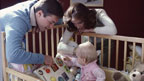
Childhood immunizations consist of vaccines made of weakened or "killed" versions of certain disease-causing bacteria and viruses. They stimulate the child's immune system to build up antibodies to the diseases, and make it much less likely the child ever will contract the disease.
Typical costs:
Immunizations for the first year cost at least $620, while the average total cost for all vaccines needed during childhood and adolescence is about $1,170. The total cost includes the cost of the vaccine itself and administration by a health care professional.
Most private health insurance -- about 80 percent -- covers baby immunizations recommended by the U.S. Centers for Disease Control & Prevention[1] and required by schools. However, a small percentage of plans either do not cover childhood immunizations or do not offer adequate coverage; for example, some plans do not cover the chicken pox vaccine. So, it is important to find out ahead of time which vaccines are covered; if your insurance does not cover a certain vaccine, it might be possible to get a referral from your doctor to a public clinic or to get a low-cost dose from a government source that your own doctor could administer.
For parents whose babies are covered by health insurance, the average out-of-pocket vaccine cost for the first year of life is $242, including copays for the four or five well baby visits where the shots usually are administered, according to one study published in the journal Pediatrics[2] .
At birth, your baby should receive the hepatitis B vaccine[3] . Then, between one and two months, your baby should receive a second dose of the Hepatitis B vaccine.
At about two months of age, your baby should receive the DtaP vaccine, the pneumococcal vaccine, the Hib vaccine, the polio vaccine and the rotovirus vaccine.
At about four months of age, your baby should receive second doses of all of the vaccines received at two months.
At about six months of age, your baby should receive third doses of the following vaccines: DTaP, Hib, pneumococcal and rotavirus.
Between six and 18 months your baby should receive a third dose of the polio vaccine and also of the Hepatitis B vaccine. And between 12 and 15 months, your baby should receive the MMR vaccine[4] . Your baby also should receive fourth doses of the Hib and pneumococcal vaccines as well as the varicella, or chickenpox, vaccine.
Keep in mind that your child will need regular vaccinations until at least age 11 or 12.The U.S. Centers for Disease Control and Prevention[5] offers a guide to childhood immunizations. And BabyCenter.com[6] offers a personalized immunization schedule tool.
Additional costs:
The influenza vaccine[7] should be given yearly before flu season starting at six months of age.
Discounts:
The CDC's Vaccines for Children Program[8] offers free or low-cost vaccines at many doctors' offices and clinics for qualifying and children, including the uninsured. Many local health departments offer free shots. For more information, you can call the CDC at 1-888-232-6348.
Shopping for baby immunizations:
Usually, the same pediatrician who handles your well baby visits will do vaccinations too. To find a pediatrician, ask a friend or family member for a referral. Or, the American Academy of Pediatrics offers a pediatrician locator service by state.
When you find a prospective pediatrician, check credentials to make sure the doctor is board-certified by the American Board of Pediatrics[9] or the American Board of Family Medicine[10] .
It also is a good idea to meet your prospective pediatrician face-to-face. Observe the waiting room and ask questions about background, areas of interest, how the doctor can be reached after-hours in an emergency, how many doctors are in the office, whether the child will be able to see the same doctor for well and sick visits and how long a typical appointment lasts. WebMD.com[11] offers a guide to selecting a pediatrician.
Despite some parents' concerns about vaccine safety, it is strongly recommended that, in most cases, parents vaccinate their children. The U.S. Centers for Disease Control and Prevention has information on why to immunize[12] , vaccine safety information for parents[13] and information on who should not be vaccinated[14] .
Material on this page is for informational purposes only and should not be construed as medical advice. For medical decisions, always consult your physician for the right course for your infant or child.
7 Lesser-Known Discounts for the 50+ Crowd As they age, members of the Baby Boomer generation don't like to admit that they're senior citizens, but they love getting discounts. It's kind of a quandary, because some of the best deals available are reduced prices for older folks. || Posted October 21 2013
7 Ways to Stretch Your Reduced Food Budget End of the year budgets are tight for everyone, especially in this economy.It's especially hard for the millions of Americans who depend on government programs like food stamps to help make ends meet. || Posted November 11 2013
At the two month visit alone, we were billed $1165 for his first 3 shots. He did have some at birth as well but I’m not sure how much those cost. We met our out of pocket max anyway but $1165 for just 3 shots is outrageous! The normal doctors visit is just $180.
11 yr old needed 1st meningococcal vaccine and TDaP. I also chose to have HPV vaccination. Dallas county health dept offers $10 first visit, $5 follow up visits for uninsured and underinsured children. We fall into the latter category where ins co does not cover vaccinations and has 10,000 deductible per year.
Because I refuse to pay to inject my child with something that no one can be held responsible in the case of vaccine damage. I will not "buy in" to big pharma, cdc and medical association brainwashing for their huge profit.
We recently had our 1 year old wellness visit with the regular vaccinations and it cost us a little over $900. I had no idea the immunization a would cost so much or that they would not only charge us an office visit but an administration charge also.bno wonder people opt out of immunizations and there for uuo see a comeback in certain diseases.
If uninsured or underinsured in the DFW area, get your child's shots at the DFW Care Van for free. Being student teachers, we do not have insurance yet and our two month old needed her first set of vaccines. We got them today very easily and benevolently through this non-profit service. First come, first serve at several DFW locations throughout the year. Check out their website: www.carevan.org for schedule and instructions. Thank goodness for people and organizations like these!
$1099 billed to insurance, of which I get to pay $700. $1100 for vaccines? Guess the brat gets to go to school with a note explaining we can't do the rest.
I was charged $579.18 for the 2nd month visit. This includes doctor fee and immunization fee. I didn't have insurance at that time. Is this the right amount???
This cost estimate doesn't look right to me. Even though I didn't pay a dime, my doctor was paid about $600 for just one visit - including wellbaby and immunization. This was the 4 month visit.
Well baby visit at 12 months cost us $478 so far. There is a bill also coming for 2 other vaccines that were administered week later. And we have Anthem insurance...Vaccine administration was already $ 70-billed for insurance and $44 cost to us. Varicella vaccine billed to insurance$ 205, we have to pay $102.
CostHelper is based in Silicon Valley and provides consumers with unbiased price information about thousands of goods and services. Our writers are experienced journalists who adhere to our strict editorial ethics policy.
CostHelper Community
UTI urgent care visit Paid: 147.00 Visit was $135. Antibiotics was $12. Waiting for four hours in the waiting room and the visit was quick... [more]
Spanish Medical Interpreter Paid: 150.00 I worked with SynShyne Services out of Monroe, NC. They were so worth the price! Professional, friendly, accurate, great attitude and always on time. I recieved an itemized report after every contact and a user friendly invoice weekly... [more]
Skin prick allergy test Paid: 573.00 Took my 9 yr. old in after an allergic reaction to eggs. Several panels for nuts, fish & top 8 allergens. Sure enough, egg came up. Got a script for epinephrine and left... [more]






 Post
Post